I'm bummed I missed the Cortazar discussion last night. I was so curious how this band of b-gangers reacted to such a novel novel. I was looking forward to finding out what level of discord or satisfaction other readers felt deciphering this book. Was it all one big metaphor? What was Cortazar trying to teach us? Overall, I felt like what I've been feeling with a lot of the novels we've been reading and discussing lately: that we dissect the writer and his patterns and style (more so than the book sometimes) and how that unfolds within reading the book, and I can't help but wonder what kind of "fuck you" Cortazar was after we he set out to break so many habits of the conventional reader. Saying it now doesn't mean we haven't realized it all along with other authors. So when I use words like "plot," or "chapter," or "protagonist," know that these terms are in some sort of definition limbo, where I don't know if Cortazar used these tools to distribute his metaphors or if in some way (fucked up or genius) this was simply his version of a novel.
I chose to read Hopscotch the "traditional" way starting with chapter one and ending with fifty-six. And I must admit, I was counting on the discussion among other readers to fill me in on what I missed, having read the shorter version, and also if they felt I had indeed missed out. I thought the plot was loose and left up to my own feelings with past and current "clubs" I've found myself in where, holed up with copious amounts of cigarettes, alcohol, drugs, and wandering intelligent minds, to fill in the gaps where description didn't. Or late nights (in Paris in spirit) wandering the streets (in my mind) in search of something that's really nothing. I was thrown back to my college days when I practiced many a "quiet exercises in freedom," tortured and arrested by my own thoughts and what they were capable of. (Although, an elaborate system of threads to make sense of and choke out those mind wanderings, I doubt I could ever concoct.) And it was lovely to revisit those days of unapologetic self-destruction through Oliveira and it reminded me how much I missed thinking, speaking, and writing outside of logical habit. He called the club once "a band of failures . . . bothered by legality when some logic begins to function too well." (Screw/I love you Cortazar!) Once again, I couldn't help but think of JC and who he is and for that matter, what role mate, jazz, and Goulouise cigarettes play in his life. I can understand him having some personal connection to Oliveira, culturally speaking, but there was so much more to this book than the protagonist. And my creative mind begs to know, where did the rest come from? I also thought: Jean-luc Godard's film Band a part. Anyone else?
So was Cortazar looking to break down this conventional wisdom or was he simply just answering his personal needs as a writer? I think we can all agree that the language was beautiful and some of the existential ideas presented were provocative and amusing. I think it was Babs, writing "a story about a sound" . . . or Oliveira being a "firm believer in autosuggestion." And then there was chapter 34. Oh chapter 34 how I loathed and loved reading you! I would giggle out loud as my eyes crossed again and again trying read every other line! And after reading the same line five times give in and switch to the other letter. I was furious at the same time I had to applaud Cortazar for this new experience. And it went back and forth like this the entire novel. So how can I form a solid opinion on such a wobbly (but not hollow) book?
That's where bookgang would have been nice. Having missed last night, I feel restless and unsettled about the whole book. So this is surely one that will stay with me for a while at least until I can work it out. Jury's still out. Perhaps a mate and a Goulouise a walk on a Parisian street will do the trick.
What's up next?! See the googledoc Hit List for suggestions.
Monday, May 11, 2009

Wednesday, April 8, 2009
Crap in My Oatmeal: A Memoir

Glaring at me from my clutter ridden desk is this damn copy of a book I forgot to return to Barnes and Noble. It sits on the corner, gathering dust and my loathing. Why do I have to write something about you, you piece of crap? My life would be perfect if it weren’t for your passive aggressive presence, reminding me of my own procrastinations...
It took a while to get over my initial disdain for Saunder’s Pastoralia. I have a programmed revulsion to most postmodern-y works; something about them generally leave me feeling empty and dissatisfied. Upon completing this collection of short stories, I had to ask myself if the dread I felt was a result of the book, the postmodern movement, or, god forbid, my own meager existence.
There is something unsettlingly familiar about the characters that populate these stories. They are pathetic and two dimensional. They are insecure, dependent, petty and unattractive—everything I consciously aspire not to be. Reading this book is like passing through a crackerjack town that I thankfully never lived in. If I had, I would have been so glad to leave it behind.
These stories is just that: a collection of tales from forgotten towns about goofy rednecks that are easy targets of our ridicule. The bizarre settings, absurd situations and stylized rhetoric hyperbolize the struggles of these characters. They become caricatures that remind us of our own dissatisfactions and possible failures.
A pastoral is a picture representing the shepherd’s life. It evokes a sentimentality for rural expanses and simpler times. The title of this book is suspect. Though the settings and inhabitants appear simple, they are involved in complicated and often perverse relationships. Saunders is a gifted humorist. His timing is impeccable, and his impressions make us laugh and guffaw. Then we burn rubber, spray gravel, and get the hell out of dodge.
I guess this dread I feel is that we left them all behind. Ultimately, Saunders does not deliver his characters from their own tragedies, as though holding up that dirty mirror was all he cared to do. His limited action implies that they are the only saboteurs of their own potential, and to give hope is merely to enable their dependencies.
Meanwhile, in NYC, where sexy people live sexy lives...
The meeting was lovely and animated as always. The flock of us, including newcomer Jules, descended on "Mother's" for a round of brews, fries and intellectual snobbery, really, discussing a book in a Brooklyn bar on a Saturday night? Yes, the atmosphere was a little loud for our discussion, yes the other patrons looked at us over their shoulders, what curious people, this band of beautiful intelligentsia... And what pleasant prelude to the debauchery that ensued. Round two rolled around in the form of my 30th birfday party and I had a blast, I hope y'all did too!
~Shomsie
p.s. the pix that follow are courtesy of Mr. Watt, I do not own a mac, so most of the pix didn't convert =(


and, one final p.s.
this is an excerpt from an essay by the late David Foster Wallace that I was trying to work into this bookgang post before I realized I was practically writing a term paper. It relates to my feeling of helplessenss and dread...the essay is called "E Unibus Pluram: Television and U.S. Fiction" and appears in the collection "A Supposedly Fun Thing I Will Never Do Again."
"...So then how have irony, irreverence, and rebellion come to be not liberating but enfeebling in the culture today’s avant-garde tried to write about? One clue’s to be found in the fact that irony is still around, bigger than ever after 30 long years as the dominant mode of hip expression. It’s not a rhetorical mode that wears well. As [Lewis] Hyde. . .puts it, "Irony has only emergency use. Carried over time, it is the voice of the trapped who have come to enjoy the cage." This is because irony, entertaining as it is, serves an almost exclusively negative function. It’s critical and destructive, a ground-clearing. Surely this is the way our postmodern fathers saw it. But irony’s singularly unuseful when it comes to constructing anything to replace the hypocrisies it debunks. This is why Hyde seems right about persistent irony being tiresome. It is unmeaty. Even gifted ironists work best in sound bites. I find gifted ironists sort of wickedly funny to listen to at parties, but I always walk away feeling like I’ve had several radical surgical procedures. And as for actually driving cross-country with a gifted ironist, or sitting through a 300-page novel full of nothing by trendy sardonic exhaustion, one ends up feeling not only empty but somehow. . .oppressed."
Sunday, March 8, 2009
post-Saunders and looking forward
Hey gang. I was lonely so I wanted to write a blog post. I only took one pict at our last meeting, so please see below.

Anyone know of any good upcoming literary events? Email please, if you do!
I saw some fellow book gangsters this weekend and we discussed the necessity of selecting a place with good volume levels to hold meetings. A couple of bars we've met at had background noise levels which were less than (or should I say GREATER than?) optimal. Second Chance Saloon, while a fine place to elbow punkers in the guts and get beer spilled on you, is not a great place for a book meeting, volumewise. Mother's had a lot of perks, fine beers and $5 burgers for those of us who eat meat, yet I felt like I was my aging Viet Nam vet father screaming across the table, "Eh sonny? What was that? You think Saunders might be stuck in his Phallic Stage, speaking Freudiantly, and has some weird attachment to his mother and therefore writes about all these relationships where an imperfect, damaged guy is trapped with a faulty female, yet refuses to change his situation? What?"
That said, I am heartily looking forward to some peace and beatitude in the Park Slope area in a few weekends here, where we can brunch together in a controlled-volume atmosphere. I can't wait to try out some fancy schmancy recipes, my new waffle iron, and maybe even whip up homemade whipped creme. Has anyone gotten the book yet? Further, what does the M.F.K. stand for in M.F.K. Fisher? Can I take a guess? Master of Friccassee Kabobs Fisher.
Did we ever come up with what the acronym FIRPO stands for? When I google'd it, I got the Wikipedia.com page for boxer Luis Angel Firpo. I think we can come up with a better acronym than that!
--Jenna

Anyone know of any good upcoming literary events? Email please, if you do!
I saw some fellow book gangsters this weekend and we discussed the necessity of selecting a place with good volume levels to hold meetings. A couple of bars we've met at had background noise levels which were less than (or should I say GREATER than?) optimal. Second Chance Saloon, while a fine place to elbow punkers in the guts and get beer spilled on you, is not a great place for a book meeting, volumewise. Mother's had a lot of perks, fine beers and $5 burgers for those of us who eat meat, yet I felt like I was my aging Viet Nam vet father screaming across the table, "Eh sonny? What was that? You think Saunders might be stuck in his Phallic Stage, speaking Freudiantly, and has some weird attachment to his mother and therefore writes about all these relationships where an imperfect, damaged guy is trapped with a faulty female, yet refuses to change his situation? What?"
That said, I am heartily looking forward to some peace and beatitude in the Park Slope area in a few weekends here, where we can brunch together in a controlled-volume atmosphere. I can't wait to try out some fancy schmancy recipes, my new waffle iron, and maybe even whip up homemade whipped creme. Has anyone gotten the book yet? Further, what does the M.F.K. stand for in M.F.K. Fisher? Can I take a guess? Master of Friccassee Kabobs Fisher.
Did we ever come up with what the acronym FIRPO stands for? When I google'd it, I got the Wikipedia.com page for boxer Luis Angel Firpo. I think we can come up with a better acronym than that!
--Jenna
Sunday, January 18, 2009
Bookgang Takes a Bath with Tolstoy

In the chapter on Anna Karenina in his Lectures on Russian Literature, Vladimir Nabokov insists “that literature is not a pattern of ideas but a pattern of images. Ideas do not matter much in comparison to a book’s imagery and magic.”
Bookgang is also not without patterns. Our uniformly good looks and intellectual agility certainly stand out. And month after month, our epicurean acumen manifests itself in the swirl of fine wine in our chinking glasses and the array of foods sweet and savory that pass our lips – a pattern that Oblonsky would call first-rate. If there was a pattern among Bookgang’s experience with reading Tolstoy’s canonical masterpiece, it was one of procrastination: despite New York’s best efforts to snow us in or otherwise chill our efforts to leave our snug apartments, our calendars often prevailed and left most of us rushing to finish the reading. But finish we did, most of us anyway, and we celebrated breaking this literary ribbon with a trip to the Russian and Turkish Baths in the East Village. Sadly, no cameras are allowed inside so you’ll just have to trust me when I declare myself the out-and-out winner in the contest of the hirsute chests: consider it my Slavic badge of honor.
It had snowed on and off all that day, so the transition from icy afternoon to reclining in the blaze of the bathhouse seemed that much more incongruous, and unlikely, some kind of instant cure for the disguised ailments of winter. No wonder then, the popular tradition of Russians like Tolstoy’s tubercular Nikolai traveling to Europe to “take the waters.” The Russian room was so hot I began to fear my facial piercings would burn me. When our blood collectively reached a point of brain boiling, a few of us went out onto the open air deck, our heads wet, the girls in their bikinis and we men in the uniform - those unflattering light blue bathhouse shorts. A gentle snow sifted down. We stood impervious to cold and smiling at the world from inside the warm halo of our bodies. On the bench nearby some people were drinking beer and drawing on a spliff. Sebastian bummed a smoke. Yelena walked barefoot through an arm of snow. It was quiet and perfect, and high time to talk books and get some damn food. For those purposes, we made our way to the Russian themed Anyway Café, whose “Russian bloody martinis” – made with the house’s remarkable infused vodkas – could make even the most ardent capitalist see the virtues of going red.
Just as the meal arrived, so did Emily, and Bookgang did what it always does so well: parse the “image and magic” of literature into the realm of ideas.
Hours later, we stepped outside to discover the weather had been as animated as we had been. The streets of New York were white as a new egg. We stood at the corner of Second Avenue. It was a Sunday night and it had that Sunday feeling, when your heart fills out like a sail. The faces of my friends were collectively flushed, a rosy afterglow earned from the baths, from the food and drink, from the time (and dollars) well spent with in the company of one another and Mr. Tolstoy. From the heavens fell a rich, downy snow as if the clouds were tossing confetti. The East Village was quiet, and the streetlamps and storefronts emitted a golden light. Anna Karenina is a book about life; fitting, then, that our night ended with a magical image of what life is all about.
- Jason Watt


Tuesday, October 28, 2008
Bohumil Hrabal: A Conversation Between Infinity and Eternity
 In a collective BookGang misstep, rather than meet at the thematically appropriate Czech Beer Garden in Queens or Brooklyn's beerhall equivalent, Radegast, we convened at Rose's Live Music to discuss I Served the King of England, a novel by the late Bohumil Hrabal, Czech author and pub enthusiast. (With four of us gangsters having traveled to Prague, how'd we get the location so wrong?) As a consequence, we spent the first fifteen minutes critiquing Rose's service, rather than the book. Ironic, given much of the novel's plot involves restaurant service (the title refers to an oft-uttered line by a masterful maitre d').
The protagonist is Ditie, a very short and rather simple character who at the start the book sells weiners for the Golden Prague Hotel, all the while pining for wealth and recognition. The first three-quarters of the book read as hilarious picaresque, as Ditie bounces from one Hotel to another, accruing wealth and a kind of wordly wisdom (and romantic encounters). As our fool kicks around different hotels, he finds himself in the company of eccentric salesmen and poets, hoteliers and politicans - including the President and the Emperor of Ethiopia. The emperor's meal makes a dish like turducken seem sane and humble by comparison. But it's not all laughs: Ditie delivers passages of sheer poetic beauty, as when when he recalls living with his grandmother in a mill, just below a bathhouse frequented by traveling salesmen. The salesmen would often check their old underclothes out the bathouse window. He and his grandmother would wait for these moments; she, to mend the shirts; he, to bask in the unlikely aesthetic beauty that transforms this otherwise mundane moment into one of grace:
"Sometimes shirts that got trhown out would suddenly spread their arms like a traffic cop at an intersection, or like Christ, and the shirts would be crucified in midair for a moment, and then plunge headlong onto the rim or blades of the mill wheel... it was wonderful to see white underwear suddenly fly out of the bathroom window in the Charles Baths and flutter down through the darkness, a white shirt against the black abyss of the current, flashing for an instant outside our window, and float down into the depths to land on the gleaming wet blades."The above image foreshadows the eloquent spiritual lens through which Ditie sees the world in the last third of the book. By that time, has gained and lost his own hotel and fortune, gained and lost a wife and child, and retreated into the remote countryside where he mends roads. His only company at this point are a dog, horse, goat and cat; a strange work crew, but hardly his wildest. Ditie has relinquished his ambitions and now dispenses his distilled wisdom over Urqells at the backwater village where he buys supplies.
"...whenever I was in the pub I realized that the basic thing in life is questioning death, wanting to know how we'll act when our time comes, and that death, or rather this questioning of death, is a conversation that takes place between infinity and eternity, and how we deal with our own death is the beginning of what is beautiful, because the absurd things in our lives, which always end before we want them to anyway, fill us, when we contemplate death, with bitterness and therefore with beauty."And of beauty? "Beauty always points to infinity and eternity."
Dittie's abstract musings contrast sharply against his earlier revelations, like the joys to be found in Paradise, the brothel he frequents as a teenager, just as his voluntary withdrawal into the barren countryside differs from the warmth and human noise of the novel's earlier scenes. (Which, by the way, are hilarious.) The chill and solitude Ditie embraces makes for good discussion, but they also come at a price, for readers anyway: the isolated philosophizing creates narrative drag and, as if to compensate for the freeze on action, Hrabal keeps pointing out various ways in which "the unbelievable came true" - which reads a bit thin, compared the incredible (and incredibly) numerous memorable events that give the young Ditie his formative experience and make the novel one worthy of our highest praise.
-Jason Watt
James Wood, staff writer at the New Yorker and a fine, fine critic, has more to say about the book and its author here.Next: We'll be reading Tolstoy's Anna Karenina, the Pevear / Volokhonsky translation. We'll discuss parts 1-4 on Sunday, December 14th, and parts 4-8 sometime in January. Times and Places TBD.


Tuesday, October 14, 2008
Kundera rats out a spy, media assassinates an author
This from the New York Times, 10/14/2008:
"Report Says Acclaimed Czech Writer Informed on a Supposed Spy
By RACHEL DONADIO
Published: October 13, 2008
In a revelation that could tarnish the legacy of one of the best-known Eastern European writers, a Czech research institute published a report on Monday indicating that the young Milan Kundera told the police about a supposed spy.
According to the state-backed Institute for the Study of Totalitarian Regimes, in 1950, long before he became famous for darkly comic novels like “The Unbearable Lightness of Being” and “The Joke,” Mr. Kundera, who was then 21, told the local police about a guest in a student dormitory where he lived.
The police quickly arrested the man, Miroslav Dvoracek, who had defected to Germany in 1948 and was said to have been recruited by United States-backed anti-Communists as a spy against the Czech government. He was sentenced to 22 years in prison. Mr. Dvoracek narrowly escaped the death penalty, a common punishment for espionage, and eventually served a 14-year sentence, including hard labor in a uranium mine.
The allegations could diminish Mr. Kundera’s moral stature as a spokesman, however enigmatic, against totalitarianism’s corrosion of daily life.
The reclusive Mr. Kundera vehemently denied the account.
“I object in the strongest manner to these accusations, which are pure lies,” he said in a statement released by his French publisher, Gallimard.
In a rare interview on Monday with the Czech CTK news agency, Mr. Kundera also accused the news media of committing “the assassination of an author.”
The story is the most dramatic recent episode in Eastern Europe’s fitful reckoning with its Communist past, an era that Czechs, with their soft Velvet Revolution against the Soviet system, have been loath to explore deeply.
The report about Mr. Kundera also recalls the case of the German writer Günter Grass, a Nobel laureate, who disclosed in 2006 that he had been a volunteer in the Waffen-SS as a teenager during World War II.
The report also speaks to Mr. Kundera’s vexed relationship with his former homeland. He was a staunch member of the Communist Party until the Soviet invasion in 1968, when he was fired from his teaching post and his work was banned. Expelled from the party in 1970, he emigrated to France in 1975 and has lived there ever since, taking French citizenship. He is respected but not loved in the Czech Republic, where many of his recent books, written in French, have not been translated.
In the interview with the Czech news agency, Mr. Kundera said: “My memory has not tricked me. I did not work for the secret police.”
Yet the institute’s claims do not link him to the secret police. Instead, with its combination of specificity and mystery, a local police report from the time reads like something out of Mr. Kundera’s writing.
Dated March 14, 1950, during the Stalinist terror, it states that “Milan Kundera, student, born on 1 April 1929 in Brno, resident at the Prague VII student hall of residence,” went to the local police at 4 p.m. and made a statement about Iva Militka, another student from the residence.
According to the report, Mr. Kundera learned that Ms. Militka had told a fellow student that she met Mr. Dvoracek, who said he had deserted Czech military service and fled to Germany. He asked her to hold a briefcase “for safekeeping.” Informed by Mr. Kundera about the briefcase, police officers waited for Mr. Dvoracek to return, found that he had a false identity document and arrested him.
The suitcase contained “two hats, two pairs of gloves, two pairs of sunglasses and a tube of cream.”
The claims emerged only now, more than 50 years after the arrest, when a researcher for the Institute for the Study of Totalitarian Regimes stumbled onto the police report “by accident” earlier this year, said Vojtech Ripka, the director of the institute’s documentation unit. The institute, which opened in February, was created by the government to research the country’s Communist and Nazi past.
The researcher, Adam Hradilek, was investigating cases like that of Mr. Dvoracek’s: Czechs who fled to Germany after the Communist invasion of Czechoslovakia in 1948 and returned to spy on the Prague government.
Mr. Hradilek and a co-author, Peter Tresnak, published their findings on Monday in Respekt, a Czech political weekly magazine. Martin Simecka, the editor in chief of Respekt, said he had no reason to doubt the authenticity of the police report.
Mr. Simecka said that if the Czech authorities had known about the document in the 1970s, they might have used it against Mr. Kundera.
For his part, Mr. Dvoracek suffered a stroke in June and can no longer speak, his wife, Marketa Dvoracek Novak, said in a telephone interview from the couple’s home in Sweden, where they have lived since Mr. Dvoracek’s release from prison in 1964.
She said Mr. Hradilek last week showed her a copy of the police report naming Mr. Kundera, and she had shown it to her husband. “Yes, he understood it, but it didn’t make much difference,” she said. “He just waved his hand. After a whole life, it doesn’t matter. It’s too late.”
She said her husband did not care who had turned him in. “It doesn’t really matter to him whether it was some very famous bad guy who was the informant, or someone who was not famous at all,” she said.
Nor did she expect an apology or explanation from Mr. Kundera. “No, no, no — that is irrelevant,” she said. “To apologize after 58 years? No.”
Mr. Ripka, of the institute, said he was disappointed Mr. Kundera had not responded more fully.
“We regret that he doesn’t speak more specifically about the case, because he definitely knows more information,” Mr. Ripka said. He denied Mr. Kundera’s claim that the institute had unjustly singled out the author. “We really don’t search archives for attractive information for the media,” he said.
Roberto Calasso, a close friend of Mr. Kundera’s who is the director of Mr. Kundera’s Italian publisher, Adelphi, said the claims stemmed from “a strong acrimony that his country has for him.”
Some others saw the report in a different light.
“I would say this would not be out of character for Kundera or anyone who was so young and so dedicated to the Communist cause,” said Michael Kraus, a Prague native and professor at Middlebury College in Vermont, who served on the advisory board that helped establish the research institute.
Although Mr. Kundera’s views later evolved, Mr. Kraus said, back then he was “a true believer.”
“If in fact this is what he did,” Mr. Kraus added, “he was just simply doing his patriotic duty, as he saw it.”
In an interview published in The New York Times in 1985, Mr. Kundera discussed his belief in privacy.
“We live in an age when private life is being destroyed,” he said. “The police destroy it in Communist countries, journalists threaten it in democratic countries, and little by little the people themselves lose their taste for private life and their sense of it,” he said then.
“Without secrecy,” he added, “nothing is possible — not love, not friendship.”"
"Report Says Acclaimed Czech Writer Informed on a Supposed Spy
By RACHEL DONADIO
Published: October 13, 2008
In a revelation that could tarnish the legacy of one of the best-known Eastern European writers, a Czech research institute published a report on Monday indicating that the young Milan Kundera told the police about a supposed spy.
According to the state-backed Institute for the Study of Totalitarian Regimes, in 1950, long before he became famous for darkly comic novels like “The Unbearable Lightness of Being” and “The Joke,” Mr. Kundera, who was then 21, told the local police about a guest in a student dormitory where he lived.
The police quickly arrested the man, Miroslav Dvoracek, who had defected to Germany in 1948 and was said to have been recruited by United States-backed anti-Communists as a spy against the Czech government. He was sentenced to 22 years in prison. Mr. Dvoracek narrowly escaped the death penalty, a common punishment for espionage, and eventually served a 14-year sentence, including hard labor in a uranium mine.
The allegations could diminish Mr. Kundera’s moral stature as a spokesman, however enigmatic, against totalitarianism’s corrosion of daily life.
The reclusive Mr. Kundera vehemently denied the account.
“I object in the strongest manner to these accusations, which are pure lies,” he said in a statement released by his French publisher, Gallimard.
In a rare interview on Monday with the Czech CTK news agency, Mr. Kundera also accused the news media of committing “the assassination of an author.”
The story is the most dramatic recent episode in Eastern Europe’s fitful reckoning with its Communist past, an era that Czechs, with their soft Velvet Revolution against the Soviet system, have been loath to explore deeply.
The report about Mr. Kundera also recalls the case of the German writer Günter Grass, a Nobel laureate, who disclosed in 2006 that he had been a volunteer in the Waffen-SS as a teenager during World War II.
The report also speaks to Mr. Kundera’s vexed relationship with his former homeland. He was a staunch member of the Communist Party until the Soviet invasion in 1968, when he was fired from his teaching post and his work was banned. Expelled from the party in 1970, he emigrated to France in 1975 and has lived there ever since, taking French citizenship. He is respected but not loved in the Czech Republic, where many of his recent books, written in French, have not been translated.
In the interview with the Czech news agency, Mr. Kundera said: “My memory has not tricked me. I did not work for the secret police.”
Yet the institute’s claims do not link him to the secret police. Instead, with its combination of specificity and mystery, a local police report from the time reads like something out of Mr. Kundera’s writing.
Dated March 14, 1950, during the Stalinist terror, it states that “Milan Kundera, student, born on 1 April 1929 in Brno, resident at the Prague VII student hall of residence,” went to the local police at 4 p.m. and made a statement about Iva Militka, another student from the residence.
According to the report, Mr. Kundera learned that Ms. Militka had told a fellow student that she met Mr. Dvoracek, who said he had deserted Czech military service and fled to Germany. He asked her to hold a briefcase “for safekeeping.” Informed by Mr. Kundera about the briefcase, police officers waited for Mr. Dvoracek to return, found that he had a false identity document and arrested him.
The suitcase contained “two hats, two pairs of gloves, two pairs of sunglasses and a tube of cream.”
The claims emerged only now, more than 50 years after the arrest, when a researcher for the Institute for the Study of Totalitarian Regimes stumbled onto the police report “by accident” earlier this year, said Vojtech Ripka, the director of the institute’s documentation unit. The institute, which opened in February, was created by the government to research the country’s Communist and Nazi past.
The researcher, Adam Hradilek, was investigating cases like that of Mr. Dvoracek’s: Czechs who fled to Germany after the Communist invasion of Czechoslovakia in 1948 and returned to spy on the Prague government.
Mr. Hradilek and a co-author, Peter Tresnak, published their findings on Monday in Respekt, a Czech political weekly magazine. Martin Simecka, the editor in chief of Respekt, said he had no reason to doubt the authenticity of the police report.
Mr. Simecka said that if the Czech authorities had known about the document in the 1970s, they might have used it against Mr. Kundera.
For his part, Mr. Dvoracek suffered a stroke in June and can no longer speak, his wife, Marketa Dvoracek Novak, said in a telephone interview from the couple’s home in Sweden, where they have lived since Mr. Dvoracek’s release from prison in 1964.
She said Mr. Hradilek last week showed her a copy of the police report naming Mr. Kundera, and she had shown it to her husband. “Yes, he understood it, but it didn’t make much difference,” she said. “He just waved his hand. After a whole life, it doesn’t matter. It’s too late.”
She said her husband did not care who had turned him in. “It doesn’t really matter to him whether it was some very famous bad guy who was the informant, or someone who was not famous at all,” she said.
Nor did she expect an apology or explanation from Mr. Kundera. “No, no, no — that is irrelevant,” she said. “To apologize after 58 years? No.”
Mr. Ripka, of the institute, said he was disappointed Mr. Kundera had not responded more fully.
“We regret that he doesn’t speak more specifically about the case, because he definitely knows more information,” Mr. Ripka said. He denied Mr. Kundera’s claim that the institute had unjustly singled out the author. “We really don’t search archives for attractive information for the media,” he said.
Roberto Calasso, a close friend of Mr. Kundera’s who is the director of Mr. Kundera’s Italian publisher, Adelphi, said the claims stemmed from “a strong acrimony that his country has for him.”
Some others saw the report in a different light.
“I would say this would not be out of character for Kundera or anyone who was so young and so dedicated to the Communist cause,” said Michael Kraus, a Prague native and professor at Middlebury College in Vermont, who served on the advisory board that helped establish the research institute.
Although Mr. Kundera’s views later evolved, Mr. Kraus said, back then he was “a true believer.”
“If in fact this is what he did,” Mr. Kraus added, “he was just simply doing his patriotic duty, as he saw it.”
In an interview published in The New York Times in 1985, Mr. Kundera discussed his belief in privacy.
“We live in an age when private life is being destroyed,” he said. “The police destroy it in Communist countries, journalists threaten it in democratic countries, and little by little the people themselves lose their taste for private life and their sense of it,” he said then.
“Without secrecy,” he added, “nothing is possible — not love, not friendship.”"
Monday, September 29, 2008
From Jason's journal: Sept 29, 08 - The World W/Out Us
Today the House of Reps failed to pass their $700 billion bailout for Wall Street. The Dow dropped 700 points, and the news sites showed pictures of Congressmen looking stricken. Something needs to be done seems to be the consensus among the economic community (including my father, whom I consult on such occasions) and I'm sure something will be done, but for now I don't mind seeing our elected officials look every bit the fool they normally play (and get rich doing so...).
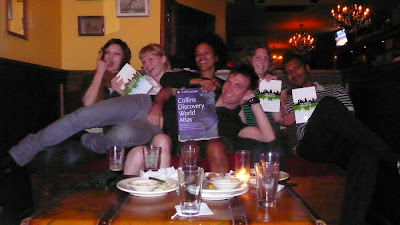
But today was also eventful in that Bookgang met for the 4th time, discussing Alan Wiseman's The World Without Us.
Stylistically, Wiseman's prose does little to engage the reader. He's not going to leave much of a thumbprint on his sentences, which tend to collect in rather blase paragraphs that offer little in the way of images, figurative language, or salient description. But they do have some serious, mind-fucking content.
The book's central conceit - what would happen to mankind's works and the world at large, should man suddenly disappear - becomes an occasion to discuss mankind's macro environmental impact. A sad story indeed. Strange but appropriate, juxtaposed to the current financial crisis, since the environmental crisis facing us on so many fronts hold far more long-term ills for both us and the planet. Yet, you'd never see the media, much less Congress, make anywhere near the effort to bail out Mother Nature - even though many of the solutions are more readily attainable and predictable. No one knows for certain whether or not a bailout will operate as intended, for example, or if the Gov't would make our money back over time, but banning plastic bags would immediately benefit the environment - though 50+ years of the fuckers will still be swimming in the oceans indefinitely.
The book made for a lively discussion about its intention = whether its intent is to encourage saner, less-damaging lifestyles or simply to make us aware of the fact that our world is fucked.
Reality was tough on us today. I, for one, look forward to going back to fiction.
PS: The next book, TBDiscussed on or around October 26 is Bohumil Hrabal's I Served the King of England.
But today was also eventful in that Bookgang met for the 4th time, discussing Alan Wiseman's The World Without Us.
 |
| From Book Gang |
Stylistically, Wiseman's prose does little to engage the reader. He's not going to leave much of a thumbprint on his sentences, which tend to collect in rather blase paragraphs that offer little in the way of images, figurative language, or salient description. But they do have some serious, mind-fucking content.
The book's central conceit - what would happen to mankind's works and the world at large, should man suddenly disappear - becomes an occasion to discuss mankind's macro environmental impact. A sad story indeed. Strange but appropriate, juxtaposed to the current financial crisis, since the environmental crisis facing us on so many fronts hold far more long-term ills for both us and the planet. Yet, you'd never see the media, much less Congress, make anywhere near the effort to bail out Mother Nature - even though many of the solutions are more readily attainable and predictable. No one knows for certain whether or not a bailout will operate as intended, for example, or if the Gov't would make our money back over time, but banning plastic bags would immediately benefit the environment - though 50+ years of the fuckers will still be swimming in the oceans indefinitely.
The book made for a lively discussion about its intention = whether its intent is to encourage saner, less-damaging lifestyles or simply to make us aware of the fact that our world is fucked.
Reality was tough on us today. I, for one, look forward to going back to fiction.
PS: The next book, TBDiscussed on or around October 26 is Bohumil Hrabal's I Served the King of England.
Subscribe to:
Posts (Atom)